




A cheap dress for a few euros, a new collection every week, and a wardrobe full of clothes we hardly ever wear. For a long time, this seemed like a win for consumers. However, behind the low prices lies a different story – millions of tonnes of textile waste, a massive CO₂ footprint, and production chains where the true cost of a garment often remains invisible.
This is precisely why the differences between fast fashion and sustainable fashion are being discussed more and more often. One system encourages people to buy more and more frequently, while the other promotes more responsible choices and longer use of what has already been produced. The difference between them is not just an environmental issue. It also affects garment quality, working conditions for employees, consumer habits, and even the amount of textile waste generated each year.
In this article, we will explore how fast fashion differs from sustainable fashion, what impact each has on the environment and people, how to identify genuinely responsible choices, and why the market for second-hand and deadstock (“stock”) clothing is becoming an important part of the circular economy.
What Is Fast Fashion and What Is Sustainable Fashion?
Fast fashion is a business model in which inexpensive, mass-produced clothing is created through extremely short collection refresh cycles – sometimes with dozens of micro-collections launched each year. This model is designed to encourage impulse purchases and low prices, which is why product ranges can change almost every week.
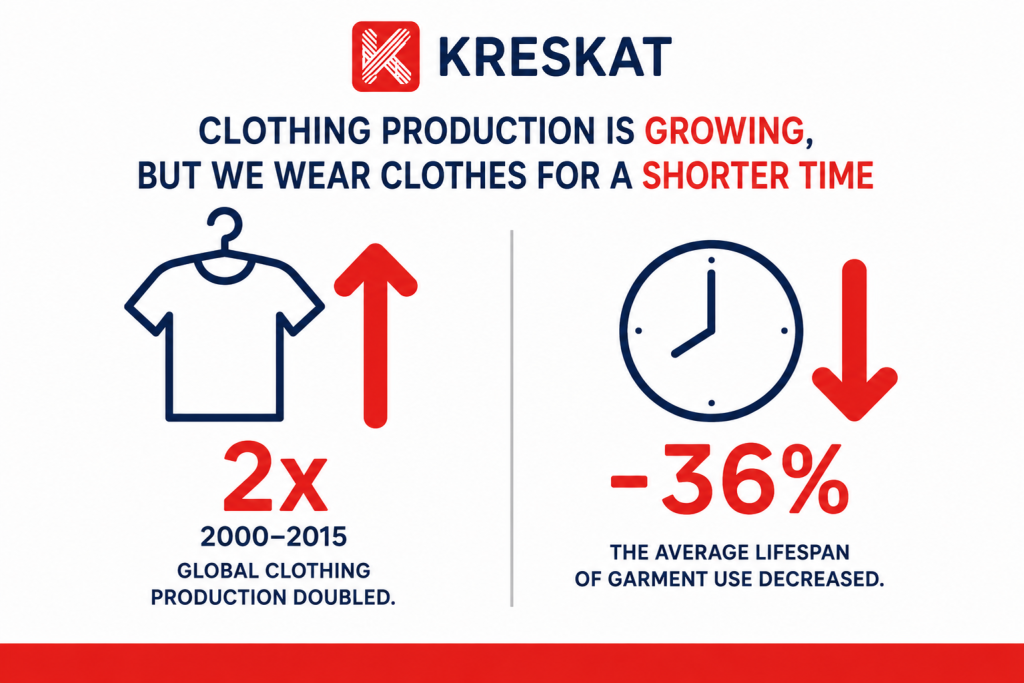
This pace helps explain the rise of fast fashion. According to data from the Ellen MacArthur Foundation, global clothing production doubled between 2000 and 2015, while the average lifespan of a garment – that is, the number of times it is worn before being discarded – decreased by 36%. This means that people are buying more clothes, but wearing each item for a shorter period of time.
Sustainable fashion, sometimes referred to as slow fashion, operates on the opposite principle. It focuses on quality, durability, responsible production, and reducing the impact on the environment while promoting the well-being of workers.
The terms differ slightly. Sustainable fashion encompasses material selection, production ethics, and the entire product life cycle – from raw material sourcing to disposal. Slow fashion, on the other hand, places greater emphasis on consumer behavior: conscious and less frequent purchasing, as well as responsible care and maintenance of products.
This contrast becomes evident when looking at the scale of consumption. Of the 19 kg of textiles purchased by the average EU resident in 2022, approximately 8 kg consisted of clothing, 7 kg of household textiles, and 4 kg of footwear.
Growing consumption shows that the logic of fast fashion still dominates, while sustainable consumption remains a conscious choice that requires a different perspective on the value of clothing and the length of its use.
Fast Fashion vs Sustainable Fashion: What Are the Differences?
The key difference lies in their priorities: fast fashion focuses on producing the highest possible volume at the lowest possible cost and speed, while sustainable fashion prioritizes durability, longevity, and minimizing environmental impact while supporting workers’ well-being. One model encourages frequent purchasing, whereas the other promotes conscious and less frequent consumption.
The contrast between these two approaches is best illustrated by comparing them across key criteria.
| Criteria | Fast Fashion | Sustainable Fashion |
| Price | Low, designed to encourage impulse purchases | Higher, reflecting the true cost of production |
| Fabric Quality | Inexpensive synthetic fibers | Natural, organic, and durable fibers |
| Production Cycles | Dozens of micro-collections per year | Less frequent, seasonal collections |
| Environmental Impact | High: pollution, waste, and CO₂ emissions | Lower due to responsible material sourcing and production practices |
| Working Conditions | Low wages and long working hours | Fair compensation and safe working conditions |
| Lifespan | Short; garments are worn for a limited time | Long; garments are worn and used for years |
The most prominent examples of fast fashion are Zara and Shein. Zara became known for its rapid collection turnover, while Shein is considered a leading example of ultra-fast fashion due to the thousands of new styles it introduces to the market in an extremely short period of time and sells at very low prices.
However, the low price can be misleading. The affordability of fast fashion does not reflect the true value of a product, as part of the costs are shifted onto the environment and workers in manufacturing countries. Since almost all stages of production take place in lower-cost regions, much of the negative impact remains invisible to the consumer.
Sustainable fashion changes the very logic of consumption. Instead of making choices based primarily on price, it encourages people to buy fewer but higher-quality products and extend their lifespan through proper care, repair, or reuse. In this way, a single durable garment can replace several inexpensive ones that quickly end up as waste.
This approach is directly linked to the second-hand clothing market, which gives already-produced garments a second life. Choosing second-hand reduces the demand for new production, making it one of the most practical ways to consume more sustainably without major compromises.
The Impact of Fast Fashion on the Environment and People
The consequences of fast fashion affect both the environment and people at the same time. Pollution, waste, and CO₂ emissions are closely linked to worker exploitation in manufacturing countries, as the same low-cost production model drives both of these problems.
Environmental Impact: Water, Waste, and CO₂
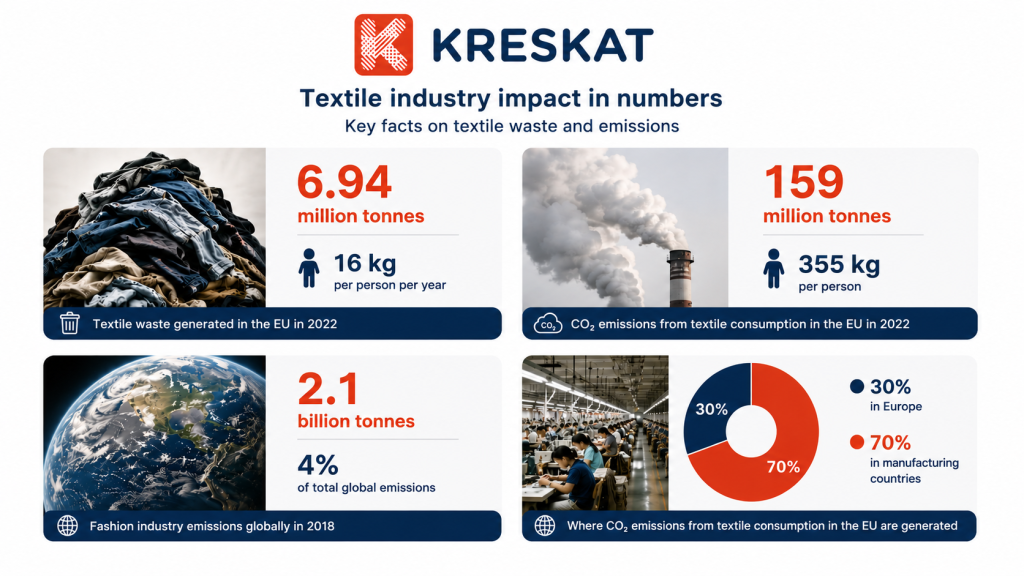
Clothing production and consumption affect the environment in several ways simultaneously: through waste generation, carbon dioxide emissions, and microplastic pollution. In 2022, EU countries generated approximately 6.94 million tonnes of textile waste, equivalent to 16 kg per person per year.
The biggest problem is not the amount of waste itself, but what happens to it afterward. In the same year, 85% of household textile waste in the EU was not collected separately, meaning it entered the mixed municipal waste stream and ultimately ended up in landfills or incineration facilities. In such cases, the materials can no longer be reused or recycled.
The climate footprint is no less significant. In 2022, the textile consumption supply chain in the EU generated 159 million tonnes of CO₂ equivalent emissions, or 355 kg per person. On a global scale, the fashion industry emitted approximately 2.1 billion tonnes of greenhouse gases in 2018, accounting for 4% of total global emissions (Ellen MacArthur Foundation).
This impact often remains invisible because most of it occurs far from the consumer. Only 30% of the greenhouse gas emissions associated with textile consumption in the EU are generated within Europe, while the remaining 70% are produced in manufacturing countries, where the majority of production processes take place. In other words, the low price of a garment is often accompanied by pollution that has been outsourced to other parts of the world.
A separate threat arises from washing synthetic fabrics. Materials such as polyester and nylon release microplastic fibers during laundering. These microscopic particles enter wastewater systems, make their way into rivers, lakes, and oceans, and eventually become part of the food chain.
Social Impact and Working Conditions
The low cost of fast fashion is often possible only because part of the production costs is shifted onto workers in developing countries. Low wages, long working hours, and unsafe working conditions become a hidden part of the price—one that is paid not by the consumer, but by garment workers in another part of the world.
The sector itself is enormous. In 2023, the EU textile and clothing industry generated a turnover of €170 billion, employing approximately 1.3 million people across 197,000 companies. However, a large share of production takes place outside Europe, where labor standards are often lower.
The relocation of production to countries with lower labor costs not only helps reduce expenses but also decreases transparency throughout the supply chain. The longer and more fragmented the supply chain becomes, the more difficult it is to determine under what conditions a particular garment was produced.
This is precisely why sustainable fashion views fair compensation and safe working conditions not as an added benefit, but as an integral part of quality. By choosing a brand that discloses its supply chain, consumers contribute to encouraging more responsible production practices.
Greenwashing and Sustainability Certifications: How to Recognize Truly Sustainable Fashion?
Greenwashing is the practice of using vague or unverifiable claims to create the impression that a product is more sustainable than it actually is. It is a marketing tactic that capitalizes on consumers’ desire to make responsible choices without delivering any meaningful reduction in environmental impact.
The main sign of greenwashing is the use of impressive-sounding but uninformative claims. Labels featuring terms such as “eco-friendly,” “green,” or “conscious” often fail to provide specific information about the materials used, the place of production, or any certifications obtained. If a claim cannot be verified, it is likely nothing more than a marketing slogan.
Fast fashion brands often employ a common strategy: they introduce a small “sustainable” or “conscious” collection that represents only a tiny portion of their overall product range. At the same time, the rest of their production continues to operate according to the same high-volume, low-cost model, meaning that the overall impact remains largely unchanged.
A more reliable indicator is the presence of independent certifications. The GOTS (Global Organic Textile Standard) certification verifies that organic cotton is used and covers oversight of the entire supply chain, including both environmental and social criteria. The EU Ecolabel, in turn, identifies products that have a lower environmental impact throughout their entire life cycle.
When choosing a garment, it is worth paying attention to several practical factors:
- the material composition listed on the label, to determine whether the fabric is natural or synthetic;
- the country of manufacture, which can help assess the transparency of the supply chain;
- the presence of certifications, rather than relying solely on marketing claims;
- the brand’s transparency about where and how its clothing is produced.
A truly sustainable brand provides facts rather than abstract claims. Transparency throughout the supply chain is one of the most reliable indicators that a brand’s sustainability promises are backed by genuine action.
Which Fabrics Should You Avoid and How Can You Make More Sustainable Choices?
It is advisable to avoid synthetic, petroleum-based fibers and choose natural or organic fabrics more often. However, the most important factor is a garment’s durability. The type of fabric affects not only comfort but also the amount of microplastic pollution and environmental impact that our clothing generates over time.
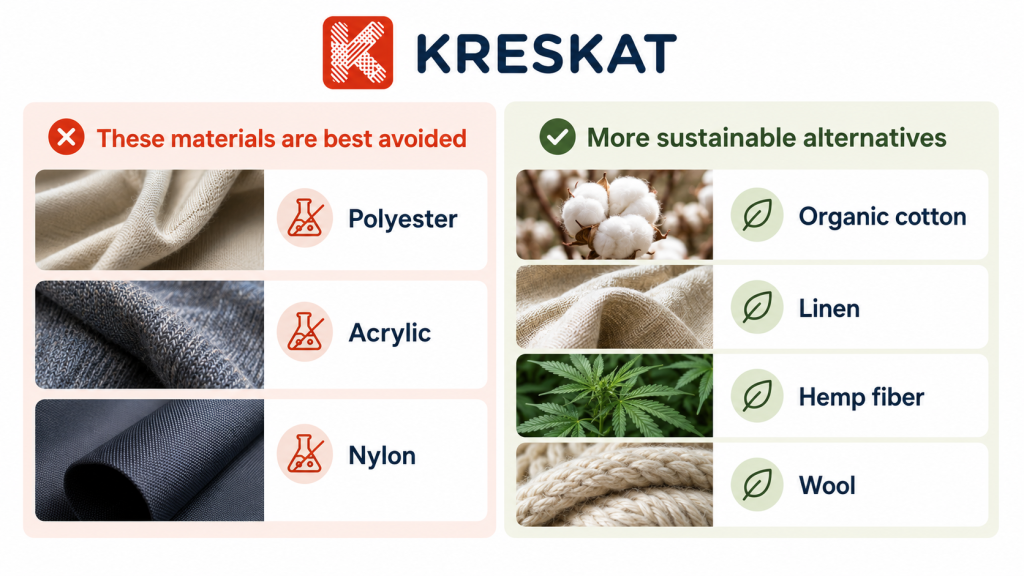
The most problematic fabrics are generally considered to be synthetic materials made from fossil fuels, as they release microplastic fibers during washing that eventually enter waterways. These materials are best avoided or, at the very least, worn and washed more responsibly:
- Polyester – the most commonly used fiber in fast fashion, made from petroleum;
- Acrylic – often used as a substitute for wool in sweaters and knitwear;
- Nylon – widely used in sportswear and lightweight clothing.
More sustainable alternatives are generally based on renewable fibers or materials that have a lower environmental impact. Many of them are biodegradable, and their production typically requires fewer chemicals:
- Organic cotton – grown without the use of synthetic pesticides;
- Linen – a durable fiber that requires relatively little water to cultivate;
- Hemp fiber – fast-growing and requiring minimal chemical inputs;
- Wool – a long-lasting and naturally biodegradable material.
However, the type of fabric is not the only factor to consider. Even a T-shirt made from organic cotton can have a significant environmental impact if it is worn only a few times before being discarded. For this reason, the number of times a garment is actually worn is often more important than the fiber it is made from.
More conscious consumption begins with a simple principle: buy less, but choose better quality. A few durable garments will last much longer than ten inexpensive items that lose their shape after only a few washes.
In practice, this means adopting a few simple habits:
- choosing denser fabrics and strong stitching that can withstand regular wear and tear;
- repairing and caring for clothing instead of discarding it because of minor defects;
- buying second-hand or deadstock (“stock”) clothing instead of purchasing new items.
Purchasing second-hand and deadstock (“stock”) clothing extends a product’s lifespan and reduces the demand for new garment production, as the same item can be worn for longer or pass through more than one owner. This choice directly supports the circular economy. For example, a selection of deadstock (“stock”) clothing gives high-quality garments the opportunity to be used rather than ending up as waste.
However, the most important message is simple: the most sustainable garment is the one you already own and continue to wear for a long time.
Textile Waste and Sustainability in Lithuania
In Lithuania, the collection rate of used textiles remains low: according to data from the Ministry of Environment, only 13% of all textiles sold in the country are collected separately. The remaining portion enters the mixed municipal waste stream, making it impossible to either recycle or reuse.
The scale of the issue is revealed by the numbers. In 2020, 57,000 tonnes of textile waste were generated within Lithuania’s mixed municipal waste stream, and 65% of this waste was either landfilled or incinerated. This means that the majority of discarded clothing is lost permanently and cannot be recovered for reuse or recycling.
The situation is changing due to new EU requirements. Since January 1, 2025, textile waste must be collected separately, and in Lithuania, municipalities are responsible for organizing this collection. As a result, they are currently expanding the network of textile waste collection containers across the country.
However, separate collection is only the first step. The greatest positive impact on sustainability comes from a circular economy, in which clothing is kept in use for as long as possible rather than becoming waste. The resale of second-hand garments extends the lifespan of products and directly reduces the need for new clothing production.
An important role in this cycle is also played by wholesale suppliers. Operating in the market for more than twenty years, Kreskat manages assortments of deadstock (“stock”) and second-hand clothing, thereby contributing to the reuse of textiles. This model transforms surplus into a resource and extends the lifespan of garments.
Fast Fashion vs Sustainable Fashion: Frequently Asked Questions
What is the difference between fast fashion and sustainable fashion?
Fast fashion focuses on rapid, low-cost, mass production, whereas sustainable fashion prioritizes quality, durability, and reducing environmental impact while supporting human well-being. The difference can be seen in pricing, production speed, and working conditions: fast fashion refreshes its collections almost every week, while sustainable fashion encourages less frequent and more conscious consumption.
Which Fabrics Should You Avoid When Choosing More Sustainable Clothing?
It is generally advisable to avoid polyester, acrylic, and nylon, as these fibers are made from fossil fuels and release microplastic particles during washing. More sustainable alternatives often include organic cotton, linen, hemp fiber, and wool. However, it is important to consider not only the type of fabric but also the garment’s durability, as even clothing made from natural fibers can have a significant environmental impact if it is worn only a few times.
How Does Fast Fashion Harm the Environment?
Fast fashion impacts the environment through excessive water consumption, microplastic pollution, the accumulation of textile waste, and greenhouse gas emissions. For example, in 2022, the EU textile consumption supply chain generated 159 million tonnes of CO₂ equivalent emissions, with the majority of this pollution occurring in manufacturing countries outside Europe.
How Can You Identify Greenwashing in the Fashion Industry?
It is worth looking for specific and verifiable information about materials, production processes, and the supply chain rather than relying on vague claims such as “eco-friendly” or “green.” A more reliable indicator is the presence of independent certifications, such as GOTS or the EU Ecolabel, as these are based on clear, measurable, and independently audited sustainability criteria.
A more sustainable approach to clothing often begins with a simple decision: extending the lifespan of textiles that have already been produced instead of driving demand for new production. This is where the second-hand and deadstock (“stock”) clothing market plays an important role, allowing large quantities of garments to remain in use for longer rather than ending up in landfills or incineration facilities.
Kreskat has been operating in this field for more than 20 years, contributing to the reuse of hundreds of tonnes of clothing every month through its wholesale second-hand clothing business. If you are looking for a reliable supplier that helps balance business needs with a more responsible approach to textile consumption, we invite you to explore our assortment and discover solutions that meet both quality and sustainability expectations.