



It is an approach to the clothing industry in which not only the price of a product is considered, but also its water consumption, CO₂ emissions, workers’ rights, and where the garment will end up after a year or two. According to definitions provided by the United Nations Environment Programme (UNEP) and UNECE, sustainability in the fashion context encompasses the entire product life cycle, as well as its environmental, social, and economic dimensions.
The topic is becoming increasingly relevant, as the fashion industry accounts for approximately 10% of global CO₂ emissions and generates around 20% of the world’s wastewater. According to some estimates, the sector’s impact may be greater than that of international aviation and shipping combined.
In Lithuania, separate collection of textile waste became mandatory on January 1, 2025, which means that the question of “how to make more conscious choices” has moved beyond the realm of marketing slogans.
The sections below provide a clear comparison between fast fashion and sustainable fashion, a list of more environmentally friendly materials, the most important sustainability certifications, and practical examples of how to apply the 5R principles in everyday wardrobe management.
What Is Sustainable Fashion? Definition and Core Principles
Sustainable fashion is a model of clothing design, production, distribution, and consumption that aims to reduce negative environmental impact and ensure social responsibility throughout a product’s entire life cycle. This approach covers every stage of the process—from raw material extraction to the recycling or reuse of the final product.
According to the assessment framework used by the United Nations Environment Programme (UNEP) and UNECE, sustainability in the fashion industry is generally evaluated across three dimensions: environmental, social, and economic. This assessment covers the entire value chain, including raw material extraction, production, transportation, use, maintenance, and recycling.
This means that a “green” product manufactured under conditions that do not meet social responsibility standards generally does not satisfy the broader definition of sustainability. Without social responsibility, it is difficult to speak of sustainability in a comprehensive sense, which is why the use of environmentally friendly materials alone is usually not enough for a garment to be considered truly sustainable.
The EU Textile Strategy for 2030 turns this direction into more concrete requirements: clothing should be more durable, easier to repair and recycle, and contain a higher proportion of recycled fibers while using fewer hazardous chemicals. At the same time, the strategy emphasizes the importance of workers’ social rights throughout the entire supply chain.
The scale of the industry explains why the topic has become so relevant. The fashion sector is responsible for around 10% of global CO₂ emissions and generates approximately 20% of the world’s wastewater. About 100 billion new garments are produced each year, and a large proportion of textiles ultimately end up in landfills or are incinerated.
As a result, sustainable fashion is increasingly understood today not as a marketing term, but as a specific set of principles and requirements encompassing environmental responsibility, ethics, and product quality.
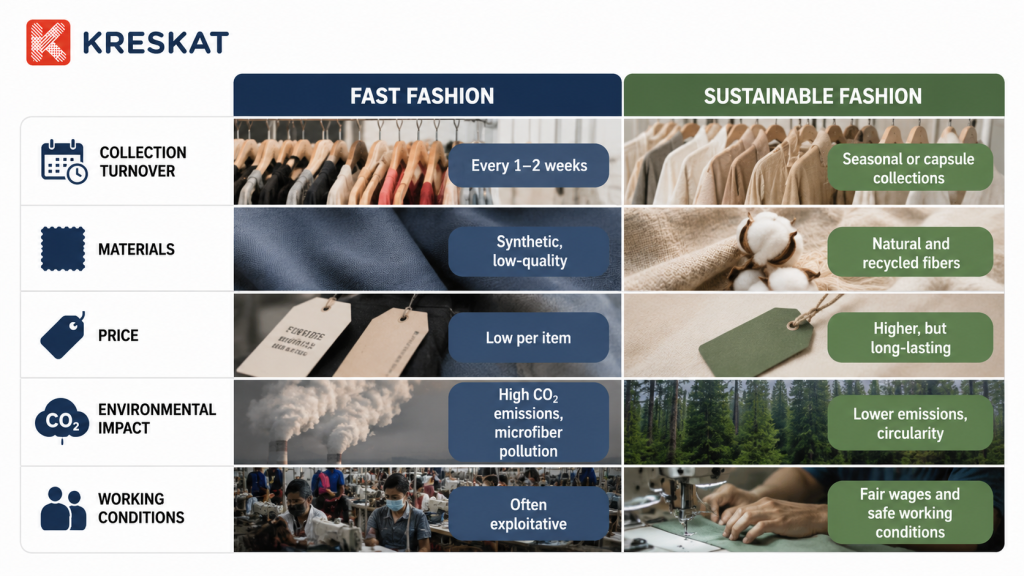
Fast fashion vs. sustainable fashion: what is the real difference?
Fast fashion is a production model based on frequent collection turnover, low-quality materials, and aggressive pricing. Garments are often designed to be inexpensive, reach stores quickly, and be used for a short period of time, meaning their lifecycle is often measured in weeks or months.
Ultra-fast fashion, often illustrated by the business models of Shein and Temu, accelerates this process even further: thousands of new styles are continuously introduced to the market and actively promoted on social media platforms through influencers.
In Lithuania, this trend may contribute to the growing textile waste problem, as separate collection of textile waste became mandatory in 2025, and a large proportion of ultra-cheap clothing becomes waste after a short period of use.
The figures illustrate the scale of this sector. Around 100 billion new garments are produced worldwide each year, while the textile industry generates approximately 1.7 billion tonnes of CO₂-equivalent emissions. According to some estimates, the sector’s impact may be greater than that of international aviation and shipping combined.
| Criterion | Fast Fashion | Sustainable Fashion |
| Collection turnover | Every 1–2 weeks | Seasonal or capsule collections |
| Materials | Synthetic, low-quality | Natural and recycled fibers |
| Price | Low per item | Higher, but long-lasting |
| Environmental impact | High CO₂ emissions, microfiber pollution | Lower emissions, circularity |
| Working conditions | Often exploitative | Fair wages and safe working conditions |
It is worth distinguishing between two concepts. Sustainable fashion is generally related to environmental impact and the entire lifecycle of a product, while ethical fashion focuses on working conditions and the treatment of people throughout the production chain. Best practice encompasses both aspects, as the concept of sustainability usually integrates both environmental and social dimensions.
Environmentally friendly materials and fabrics
The choice of material often determines a significant portion of a garment’s environmental footprint throughout its entire lifecycle—from the extraction or cultivation of raw materials to washing and disposal. According to data from the European Parliament and other widely cited public sources, producing a single pair of jeans may require approximately 7,000 litres of water, while manufacturing one cotton shirt can consume around 2,700 litres of water.
Synthetic fibers pose additional environmental challenges: when polyester, nylon, and acrylic fabrics are washed, microfibers are released into the environment, contributing to water pollution. According to some studies, approximately 0.5 million tonnes of plastic microfibers may enter the oceans each year.
As a result, the choice of material is often considered one of the most important criteria of a sustainable garment.
Natural fibers: linen, hemp, organic cotton, and wool
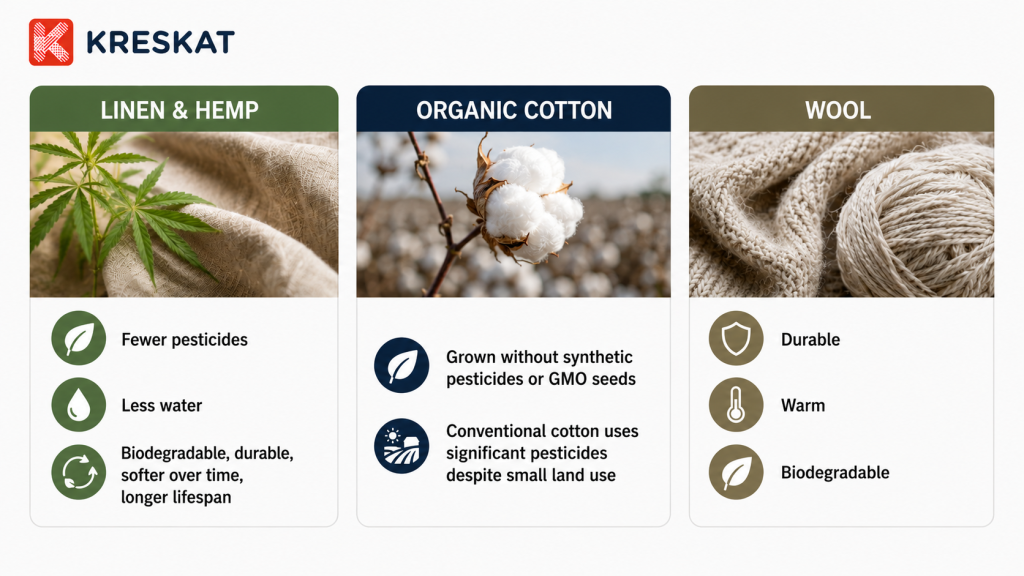
Linen and hemp are often grown using fewer pesticides and generally require less water than conventional cotton. Both fibers are biodegradable, resistant to wear and tear, and can become softer over time, which means that garments made from them often have a longer lifespan.
Organic cotton is grown without the use of synthetic pesticides or genetically modified (GMO) seeds. Conventional cotton cultivation is associated with significant pesticide and insecticide use, despite the crop occupying a relatively small share of the world’s agricultural land. According to some sources, including UNECE, cotton production may account for approximately 24% of global insecticide use and 11% of pesticide use worldwide.
The GOTS (Global Organic Textile Standard) certification generally verifies not only the organic origin of textiles, but also compliance with certain social and environmental standards.
Wool is a durable, warm, and biodegradable material, which is why it is often considered well suited to a circular fashion model. When choosing wool products, it is important to check for animal welfare certifications such as RWS (Responsible Wool Standard) or ZQ Merino, which are associated with more responsible sheep farming and wool sourcing practices.
Innovative and recycled fabrics: TENCEL, ECOVERO, and recycled polyester
TENCEL (lyocell) is a fiber made from responsibly sourced wood, most commonly eucalyptus. It is produced using a closed-loop process, meaning that a large proportion of the solvents and water used in manufacturing are recovered and reused rather than released into the environment. The fiber is biodegradable, breathable, and soft.
ECOVERO is a type of viscose made from certified wood sourced from responsibly managed forests. Compared to conventional viscose, the production of this material is generally associated with a lower CO₂ and water footprint, which is why it is often considered an alternative for everyday clothing with a reduced environmental impact.
Recycled polyester (rPET) is made from plastic bottles and textile waste. It can reduce the demand for virgin petroleum and help divert some plastic waste from landfills. However, the microfiber issue remains, as washing garments made from rPET can also release synthetic particles into the environment.
Eco-friendly clothing certifications: GOTS, OEKO-TEX, and EU ECOLABEL
Certifications are one of the most practical ways to distinguish products that meet sustainability criteria from potential greenwashing, as they are based on independent assessment and specific standards. Without certification, claims such as “eco,” “natural,” or “green” often remain marketing terms, as they lack a clearly verifiable methodology or standards-based justification.
Key textile certifications worth paying attention to:
- GOTS (Global Organic Textile Standard) applies to textiles containing a high proportion of organic fibers and covers both social and environmental criteria throughout the production chain.
- OEKO-TEX Standard 100 certifies that the levels of harmful chemicals in the finished product do not exceed established safety limits.
- EU ECOLABEL assesses a product’s environmental impact throughout its entire lifecycle—from raw material extraction to disposal.
- Fairtrade is associated with fairer compensation and improved working conditions for cotton farmers and some workers within the textile supply chain.
- GRS (Global Recycled Standard) verifies the use of recycled materials and their traceability throughout the production chain.
Greenwashing can often be identified by vague sustainability claims that are not supported by certifications or other verifiable evidence, the use of green-themed branding and design, and a lack of transparency regarding the production chain. If a brand does not disclose where and how its garments are produced, its sustainability claims often remain difficult to verify.
In circular fashion solutions, such as the second-hand clothing market, some certifications or information about a product’s origin may be carried over from the original product supply chain, while reuse generally helps reduce environmental impact.
Sustainable fashion examples and the 5R principles in practice
Sustainable fashion is often explained to consumers through the 5R principles: Reduce, Reuse, Recycle, Repair, and Rewear. This is an easy-to-understand framework that helps turn everyday choices into concrete actions.
- Reduce – buy less often and choose higher-quality items, for example by building a capsule wardrobe based on versatile combinations.
- Reuse – choose second-hand clothing, swap garments with friends, or rent outfits for special occasions.
- Recycle – dispose of worn-out textiles through separate textile collection systems, which have been mandatory in Lithuania since 2025.
- Repair – mend, alter, or re-dye a garment instead of discarding it.
- Rewear – repeatedly wear and style the same garments in different ways, moving away from a “single-use” approach to fashion.
The second-hand market demonstrates that these principles also have economic potential. In 2025, Vinted announced that it had reached approximately €10.8 billion in Gross Merchandise Value (GMV), while the McKinsey report State of Fashion 2025 forecasts that the second-hand fashion market could grow faster than the primary fashion market between 2025 and 2027.
A distinct role is played by stock clothing, meaning overproduction and deadstock inventory, which, according to various estimates, may account for approximately 4–9% of all products placed on the EU market. From 2026, the EU plans to restrict the destruction of unsold textile products, which is why stock clothing assortments are increasingly viewed as a circular economy solution rather than merely an ethical choice.
In practice, this means that new clothing can be sourced from existing inventories. For example, women’s stock clothing allows consumers to choose new, never-worn garments that often do not require an additional production cycle.
Frequently asked questions about sustainable fashion
What is an example of sustainable fashion?
An example of sustainable fashion is purchasing second-hand clothing through the Vinted platform or from physical resale stores, where a garment that has already been produced is given an additional lifecycle without the need for new production.
Another example is clothing made from organic cotton certified by GOTS, which covers both environmental and social criteria throughout the production chain. Sustainable solutions may also include products made by small Lithuanian brands that use textile offcuts or deadstock materials, which might otherwise be destroyed or left unused.
Sustainable fashion is not a single specific product, but a collection of practices – purchasing, usage, and disposal decisions taken together.
What are the 5R principles of sustainable fashion?
The 5R principles of sustainable fashion are Reduce, Reuse, Recycle, Repair, and Rewear—five principles that help structure consumers’ everyday decisions.
- Reduce means buying less and choosing higher-quality items, avoiding impulse purchases.
- Reuse involves reusing existing clothing or purchasing second-hand garments on the resale market.
- Recycle means donating textiles for recycling, particularly through separate collection points, which have been mandatory in Lithuania since 2025.
- Repair means fixing garments instead of throwing them away.
- Rewear means wearing the clothes you already own again, rather than avoiding them because of a sense of “boredom” from repeating outfits.
What is the difference between sustainable and ethical fashion?
Sustainable fashion primarily evaluates environmental impact, including material selection, water consumption, CO₂ emissions, and the amount of textile waste generated. Ethical fashion focuses more on the people within the production chain—fair wages, safe working conditions, and the prevention of child labor.
These concepts overlap, but they are not identical. A garment made from organic cotton may be produced under conditions that do not meet social responsibility standards, while an ethically produced product may be made from synthetic materials that have a greater environmental impact.
The concept of sustainability generally encompasses both dimensions, which is why more mature brands often combine environmental standards with social certifications, such as Fairtrade, and strive for greater supply chain transparency.
Does sustainable clothing really have to be expensive?
The initial price can often be higher, as higher-quality materials, certified production processes, and fairer compensation for workers generally cost more than the fast fashion model.
In the long term, the difference may decrease. A more durable garment often retains its shape and color through many washes for a longer period of time, which can reduce the need for new purchases and, consequently, lower overall spending on clothing.
One of the most accessible, more sustainable choices is to buy less and opt for second-hand or stock clothing, which is often priced lower than new fast fashion products. For many consumers, this can be a financially accessible option while also helping to reduce the amount of textile waste.
If you are looking for a practical way to contribute to the circular fashion model, second-hand and stock clothing can provide a concrete response to the direction set by the EU Textile Strategy, whose requirements are expected to become more stringent in the coming years.
KRESKAT’s wholesale warehouse gives a second life to approximately 200 tonnes of clothing every month, helping its business partners build assortments that combine economic logic with sustainability principles.
More than 20 years of experience in textile sorting helps ensure more consistent quality and a reliable supply—two factors that are often particularly important in the second-hand clothing business.
Contact us if you are planning to expand the range of second-hand or stock clothing in your store and are looking for a long-term supplier who understands market developments.